XML Tree
XML documents form a tree structure that starts at "the root" and branches to "the leaves".
The XML Tree Structure
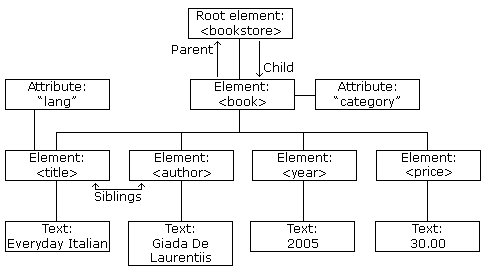
An Example XML Document
The image above represents books in this XML:
<?xml version="1.0" encoding="UTF-8"?>
<bookstore>
<book category="cooking">
<title lang="en">Everyday Italian</title>
<author>Giada De Laurentiis</author>
<year>2005</year>
<price>30.00</price>
</book>
<book category="children">
<title lang="en">Harry Potter</title>
<author>J K. Rowling</author>
<year>2005</year>
<price>29.99</price>
</book>
<book category="web">
<title lang="en">Learning XML</title>
<author>Erik T. Ray</author>
<year>2003</year>
<price>39.95</price>
</book>
</bookstore>
XML Tree Structure
XML documents are formed as element trees.
An XML tree starts at a root element and branches from the root to child elements.
All elements can have sub elements (child elements):
<root>
<child>
<subchild>.....</subchild>
</child>
</root>
The terms parent, child, and sibling are used to describe the relationships between elements.
Parents have children. Children have parents. Siblings are children on the same level (brothers and sisters).
All elements can have text content (Harry Potter) and attributes (category="cooking").
Self-Describing Syntax
XML uses a much self-describing syntax.
A prolog defines the XML version and the character encoding:
<?xml version="1.0" encoding="UTF-8"?>
The next line is the root element of the document:
<bookstore> The next line starts a <book> element:
<book category="cooking"> The <book> elements have 4 child elements: <title>, <author>, <year>, <price>.
<title lang="en">Everyday Italian</title>
<author>Giada De Laurentiis</author>
<year>2005</year>
<price>30.00</price>
The next line ends the book element:
</book>
You can assume, from this example, that the XML document contains information about books in a bookstore.

