w3schools
  
HOME HTML CSS XML JAVASCRIPT ASP PHP SQL MORE...   References Examples Forum About

XML Tree

« Previous Next Chapter »

XML documents form a tree structure that starts at "the root" and branches to "the leaves".


An Example XML Document

XML documents use a self-describing and simple syntax:

<?xml version="1.0" encoding="ISO-8859-1"?>
<note>
  <to>Tove</to>
  <from>Jani</from>
  <heading>Reminder</heading>
  <body>Don't forget me this weekend!</body>
</note>

The first line is the XML declaration. It defines the XML version (1.0) and the encoding used (ISO-8859-1 = Latin-1/West European character set).

The next line describes the root element of the document (like saying: "this document is a note"):

<note>

The next 4 lines describe 4 child elements of the root (to, from, heading, and body):

<to>Tove</to>
<from>Jani</from>
<heading>Reminder</heading>
<body>Don't forget me this weekend!</body>

And finally the last line defines the end of the root element:

</note>

You can assume, from this example, that the XML document contains a note to Tove from Jani.

Don't you agree that XML is pretty self-descriptive?


XML Documents Form a Tree Structure

XML documents must contain a root element. This element is "the parent" of all other elements.

The elements in an XML document form a document tree. The tree starts at the root and branches to the lowest level of the tree.

All elements can have sub elements (child elements):

<root>
  <child>
    <subchild>.....</subchild>
  </child>
</root>

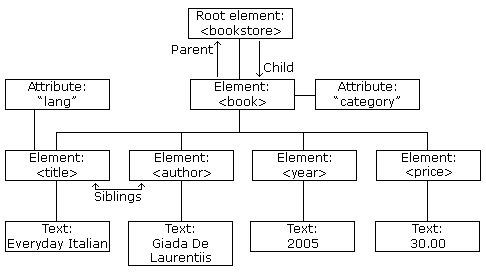
The terms parent, child, and sibling are used to describe the relationships between elements. Parent elements have children. Children on the same level are called siblings (brothers or sisters).

All elements can have text content and attributes (just like in HTML).


Example:

DOM node tree

The image above represents one book in the XML below:

<bookstore>
  <book category="COOKING">
    <title lang="en">Everyday Italian</title>
    <author>Giada De Laurentiis</author>
    <year>2005</year>
    <price>30.00</price>
  </book>
  <book category="CHILDREN">
    <title lang="en">Harry Potter</title>
    <author>J K. Rowling</author>
    <year>2005</year>
    <price>29.99</price>
  </book>
  <book category="WEB">
    <title lang="en">Learning XML</title>
    <author>Erik T. Ray</author>
    <year>2003</year>
    <price>39.95</price>
  </book>
</bookstore>

The root element in the example is <bookstore>. All <book> elements in the document are contained within <bookstore>.

The <book> element has 4 children: <title>,< author>, <year>, <price>.


« Previous Next Chapter »


Altova® MapForce®
Graphical XML Mapping Tool from the Developers of XMLSpy®

Altova MapForce

Need an easy way to get data into XML, or transform XML to another format? MapForce lets you map XML data to/from any combination of XML, database, flat file, Excel 2007, XBRL, or Web services data. Then it transforms data instantly or auto-generates royalty-free data integration code for recurrent conversions. New features in Version 2010!

Download a free, fully functional 30-day trial to experience the following features:
  • Easy-to-use, graphical data mapping interface
  • Instant data transformation
  • XSLT 1.0/2.0 and XQuery code generation
  • Java, C#, and C++ code generation
  • Advanced data processing functions
  • Support for all major relational databases including SQL Server, IBM DB2, Oracle, and more
  • Visual Studio & Eclipse integration

Download a fully-functional trial today!

  Altova MapForce


WEB HOSTING
Best Web Hosting
PHP MySQL Hosting
Top 10 Web Hosting
UK Reseller Hosting
Web Hosting
FREE Web Hosting
Top Web Hosting
Windows Hosting
WEB BUILDING
XML Editor – Free Trial!
FREE Flash Website
FREE Web Templates
FLIGHT TICKETS
Find the cheapest flight
to any destination now!
EDUCATION
US Web Design Schools
HTML Certification
JavaScript Certification
XML Certification
PHP Certification
ASP Certification
STATISTICS
Browser Statistics
Browser OS
Browser Display