Menu
×
   ❮     
HTML CSS JAVASCRIPT SQL PYTHON JAVA PHP HOW TO W3.CSS C C++ C# BOOTSTRAP REACT MYSQL JQUERY EXCEL XML DJANGO NUMPY PANDAS NODEJS DSA TYPESCRIPT ANGULAR ANGULARJS GIT POSTGRESQL MONGODB ASP AI R GO KOTLIN SWIFT SASS VUE GEN AI SCIPY AWS CYBERSECURITY DATA SCIENCE INTRO TO PROGRAMMING INTRO TO HTML & CSS BASH RUST TOOLS

HTML Tutorial

HTML HOME HTML Introduction
Introduction
Exercises
1 2 3
HTML Editors HTML Basic
Basic
Exercises
1 2 3 4 Code Challenge
HTML Elements HTML Attributes HTML Headings HTML Paragraphs HTML Styles
Styles
Exercises
1 2 3 4 5 6 7 Code Challenge
HTML Formatting HTML Quotations HTML Comments HTML Colors HTML CSS
CSS
Exercises
1 2 3 4 5 Code Challenge
HTML Links HTML Images HTML Favicon
Favicon
Exercises
1 2 3
HTML Page Title
Page Title
Exercises
1 2 3
HTML Tables HTML Lists HTML Block & Inline HTML Div
Div
Exercises
1 2 3 Code Challenge
HTML Classes
Classes
Exercises
1 2 3 4 Code Challenge
HTML Id
Id
Exercises
1 2 3 Code Challenge
HTML Buttons HTML Iframes
Iframes
Exercises
1 2 3 4 5 Code Challenge
HTML JavaScript HTML File Paths HTML Head
Head
Exercises
1 2 3 Code Challenge
HTML Layout HTML Responsive HTML Computercode HTML Semantics HTML Style Guide HTML Entities HTML Symbols HTML Emojis HTML Charsets HTML URL Encode HTML vs. XHTML

HTML Forms

HTML Forms
Forms
Exercises
1 2 3 Code Challenge
HTML Form Attributes
Form Attributes
Exercises
1 2 3
HTML Form Elements HTML Input Types HTML Input Attributes
Input Attributes
Exercises
1 2 3 4 5
Input Form Attributes

HTML Graphics

HTML Canvas HTML SVG
SVG
Exercises
Code Challenge

HTML Media

HTML Media HTML Video
Video
Exercises
Code Challenge
HTML Audio
Audio
Exercises
Code Challenge
HTML Plug-ins HTML YouTube

HTML APIs

HTML Web APIs HTML Geolocation HTML Drag and Drop HTML Web Storage HTML Web Workers HTML SSE

HTML Cert

HTML Certificate

HTML Examples

HTML Examples HTML Editor HTML Quiz HTML Exercises HTML Challenges HTML Website HTML Syllabus HTML Study Plan HTML Interview Prep HTML Bootcamp HTML Summary HTML Accessibility

HTML References

HTML Tag List HTML Attributes HTML Global Attributes HTML Browser Support HTML Events HTML Colors HTML Canvas HTML Audio/Video HTML Doctypes HTML Character Sets HTML URL Encode HTML Lang Codes HTTP Messages HTTP Methods PX to EM Converter Keyboard Shortcuts

HTML Introduction


HTML is the standard markup language for creating Web pages.


What is HTML?

  • HTML stands for Hyper Text Markup Language
  • HTML is the standard markup language for creating Web pages
  • HTML describes the structure of a Web page
  • HTML consists of a series of elements
  • HTML elements tell the browser how to display the content
  • HTML elements label pieces of content such as "this is a heading", "this is a paragraph", "this is a link", etc.

A Simple HTML Document

Example

<!DOCTYPE html>
<html>
<head>
<title>Page Title</title>
</head>
<body>

<h1>My First Heading</h1>
<p>My first paragraph.</p>

</body>
</html>
Try it Yourself »

Example Explained

  • The <!DOCTYPE html> declaration defines that this document is an HTML5 document
  • The <html> element is the root element of an HTML page
  • The <head> element contains meta information about the HTML page
  • The <title> element specifies a title for the HTML page (which is shown in the browser's title bar or in the page's tab)
  • The <body> element defines the document's body, and is a container for all the visible contents, such as headings, paragraphs, images, hyperlinks, tables, lists, etc.
  • The <h1> element defines a large heading
  • The <p> element defines a paragraph

What is an HTML Element?

An HTML element is defined by a start tag, some content, and an end tag:

<tagname> Content goes here... </tagname>

The HTML element is everything from the start tag to the end tag:

<h1>My First Heading</h1>
<p>My first paragraph.</p>
Start tag Element content End tag
<h1> My First Heading </h1>
<p> My first paragraph. </p>
<br> none none

Note: Some HTML elements have no content (like the <br> element). These elements are called empty elements. Empty elements do not have an end tag!


Web Browsers

The purpose of a web browser (Chrome, Edge, Firefox, Safari) is to read HTML documents and display them correctly.

A browser does not display the HTML tags, but uses them to determine how to display the document:
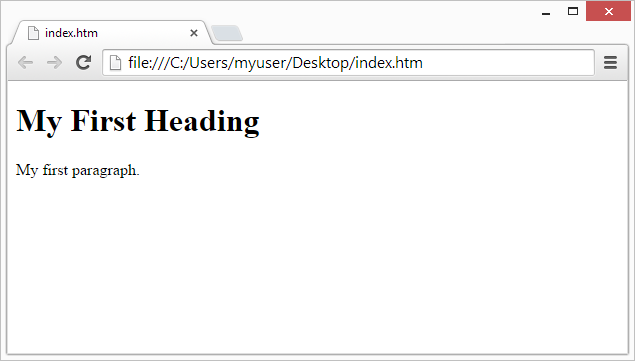
View in Browser


HTML Page Structure

Below is a visualization of an HTML page structure:

<html>
<head>
<title>Page title</title>
</head>
<body>
<h1>This is a heading</h1>
<p>This is a paragraph.</p>
<p>This is another paragraph.</p>
</body>
</html>

Note: The content inside the <body> section will be displayed in a browser. The content inside the <title> element will be shown in the browser's title bar or in the page's tab.


HTML History

Since the early days of the World Wide Web, there have been many versions of HTML:

Year Version
1989 Tim Berners-Lee invented www
1991 Tim Berners-Lee invented HTML
1993 Dave Raggett drafted HTML+
1995 HTML Working Group defined HTML 2.0
1997 W3C Recommendation: HTML 3.2
1999 W3C Recommendation: HTML 4.01
2000 W3C Recommendation: XHTML 1.0
2008 WHATWG HTML5 First Public Draft
2012 WHATWG HTML5 Living Standard
2014 W3C Recommendation: HTML5
2016 W3C Candidate Recommendation: HTML 5.1
2017 W3C Recommendation: HTML5.1 2nd Edition
2017 W3C Recommendation: HTML5.2

This tutorial follows the latest HTML5 standard.


Video: HTML Introduction

Tutorial on YouTube
Tutorial on YouTube

×

Contact Sales

If you want to use W3Schools services as an educational institution, team or enterprise, send us an e-mail:
sales@w3schools.com

Report Error

If you want to report an error, or if you want to make a suggestion, send us an e-mail:
help@w3schools.com

W3Schools is optimized for learning and training. Examples might be simplified to improve reading and learning. Tutorials, references, and examples are constantly reviewed to avoid errors, but we cannot warrant full correctness of all content. While using W3Schools, you agree to have read and accepted our terms of use, cookies and privacy policy.

Copyright 1999-2026 by Refsnes Data. All Rights Reserved. W3Schools is Powered by W3.CSS.

-->