
JavaScript Built-In Objects
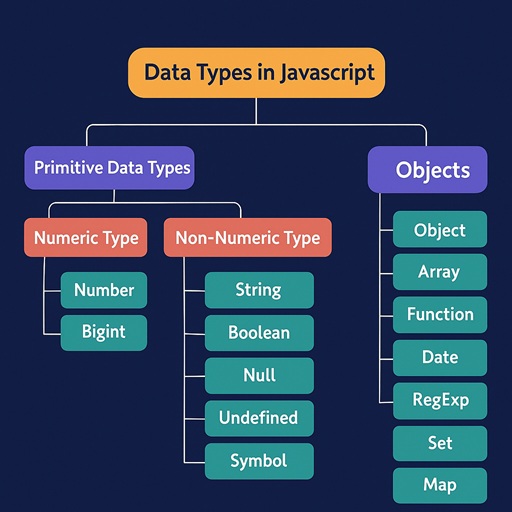
A JavaScript variable can be either a Primitive type or an Object type.
The Object data type can hold many different object types.
Examples
// Object
const person = {firstName:"John", lastName:"Doe"};
// Array Object
const cars = ["Saab", "Volvo", "BMW"];
// Date Object
const date = new Date("2022-03-25");
JavaScript Objects
JavaScript Objects represent complex data structures and functionalities beyond the primitive data types (string, number, boolean, null, undefined, symbol, bigint).
JavaScript objects are written with curly braces { }.
JavaScript objects contains a collection of different properties.
Object properties are written as name:value pairs, separated by commas.
Example
Create a person object with 4 properties: firstName, lastName, age and eyeColor:
const person = {firstName:"John", lastName:"Doe", age:50, eyeColor:"blue"};
Try it Yourself »
Learn More:
Built-In Object Types
A JavaScript object can represent a JavaScript object or a User defined object.
Built-in JavaScript object types can be:
| Object | Description |
|---|---|
| Array | Array of values accessed by a numerical index |
| Map | Array of key-value pairs where the keys can be of any data type |
| Set | Array of values where each value can only appear once |
| WeakMap | A type of Map with weak references to the stored objects. |
| WeakSet | A type of Set with weak references to the stored objects. |
| Math | An object that provides math constants and functions like PI and random() |
| Date | Object for working with dates and times |
| RegExp | Object for working with regular expressions |
| Error | Object represents error conditions during program execution |
| JSON | Object with methods for parsing values between JSON and objects |
| Promise | Object representing the completion or failure of an asynchronous operation |
| Int8Array | Array for storing fixed-size 8-bits integer values |
| Int16Array | Array for storing fixed-size 16-bits integer values |
| Int32Array | Array for storing fixed-size 32-bits integer values |
| Float16Array | Array for storing fixed-size 16-bits floating-point values |
| Float32Array | Array for storing fixed-size 32-bits floating-point values |
| Float64Array | Array for storing fixed-size 64-bits floating-point values |
| BigInt64Array | Array for storing fixed-size 64-bits big integer values |
The typeof Operator
You can use the JavaScript typeof operator to find the type
of a JavaScript variable.
The typeof operator returns the type of a variable or an expression:
Example
typeof "" // Returns
"string"
typeof "John" // Returns
"string"
typeof "John Doe" // Returns
"string"
Try it Yourself »
Example
typeof 0 // Returns
"number"
typeof 314 // Returns
"number"
typeof 3.14 // Returns
"number"
typeof (3) // Returns
"number"
typeof (3 + 4) // Returns
"number"
Try it Yourself »
Learn More:
JavaScript Arrays
JavaScript arrays are a special type of JavaScript objects.
JavaScript arrays are written with square [ ] brackets.
Array items are separated by commas.
The following code declares (creates) an array called cars, containing three
items (car names):
Array indexes are zero-based, which means the first item is [0], second is [1], and so on.